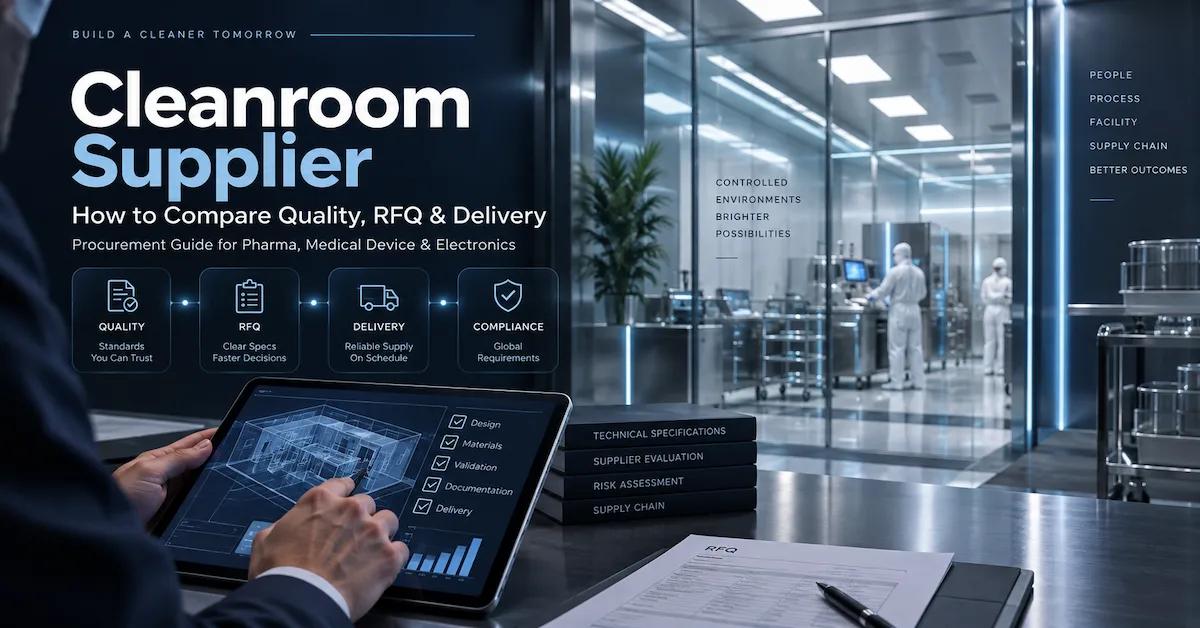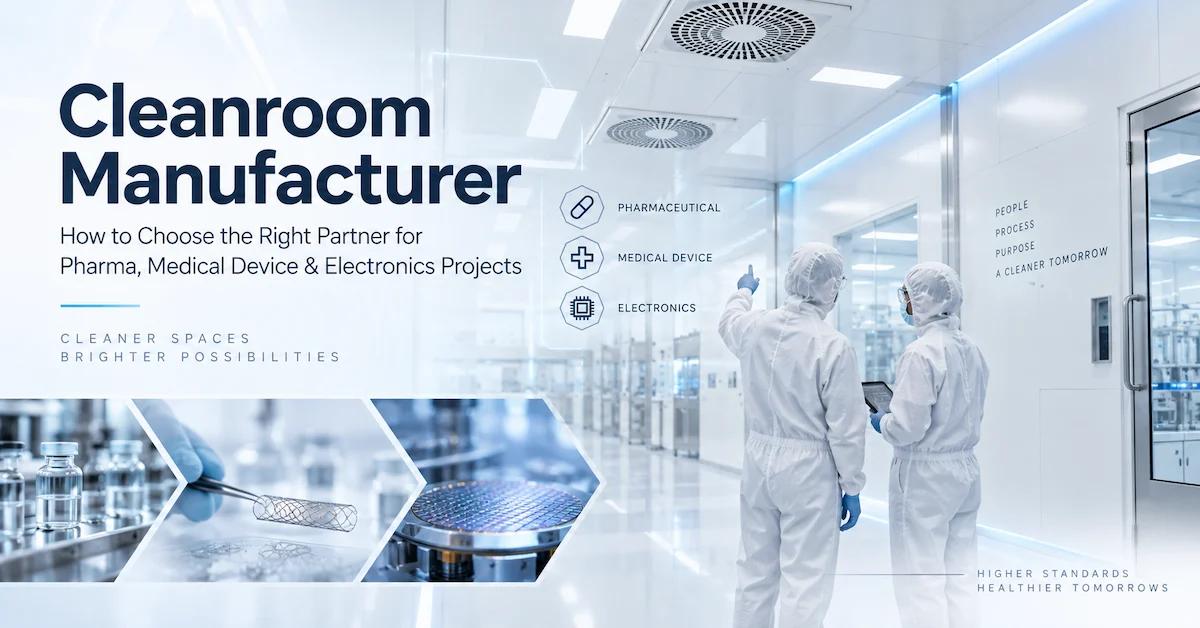

How to Choose a Reliable Cleanroom Supplier for Your Project
A reliable cleanroom supplier should provide more than equipment that looks suitable on a quotation. The supplier must demonstrate that its proposed products, engineering responsibilities, quality documentation, and delivery arrangements match the controlled environment your facility actually needs.
For pharmaceutical manufacturers, medical device companies, electronics producers, research institutions, and engineering contractors, this is an important distinction.
A cleanroom project can involve wall and ceiling systems, doors, filtration equipment, HVAC integration, environmental controls, monitoring instruments, electrical interfaces, and specialized furniture. These elements must function together after installation.
A supplier may quote competitive prices for individual components while excluding system integration, installation supervision, commissioning, or performance testing. Another supplier may offer a broader technical package at a higher initial price but with fewer responsibilities left unresolved.
The right purchasing decision depends on the complete supply scope, verified technical evidence, and total project risk—not simply the lowest equipment price.
Buyers should evaluate seven essential factors:
-
Relevant experience with the intended manufacturing process.
-
Clearly defined equipment and engineering scope.
-
Verifiable material and component specifications.
-
Quality control and technical documentation.
-
Commercial transparency and realistic delivery planning.
-
Installation, commissioning, and acceptance responsibilities.
-
After-sales support and long-term maintainability.
This guide explains how to examine those factors and turn the findings into a practical procurement process.
It also provides supplier comparison tables, technical documentation checklists, quotation evaluation criteria, and a cleanroom RFQ framework that can be used before requesting a formal proposal.
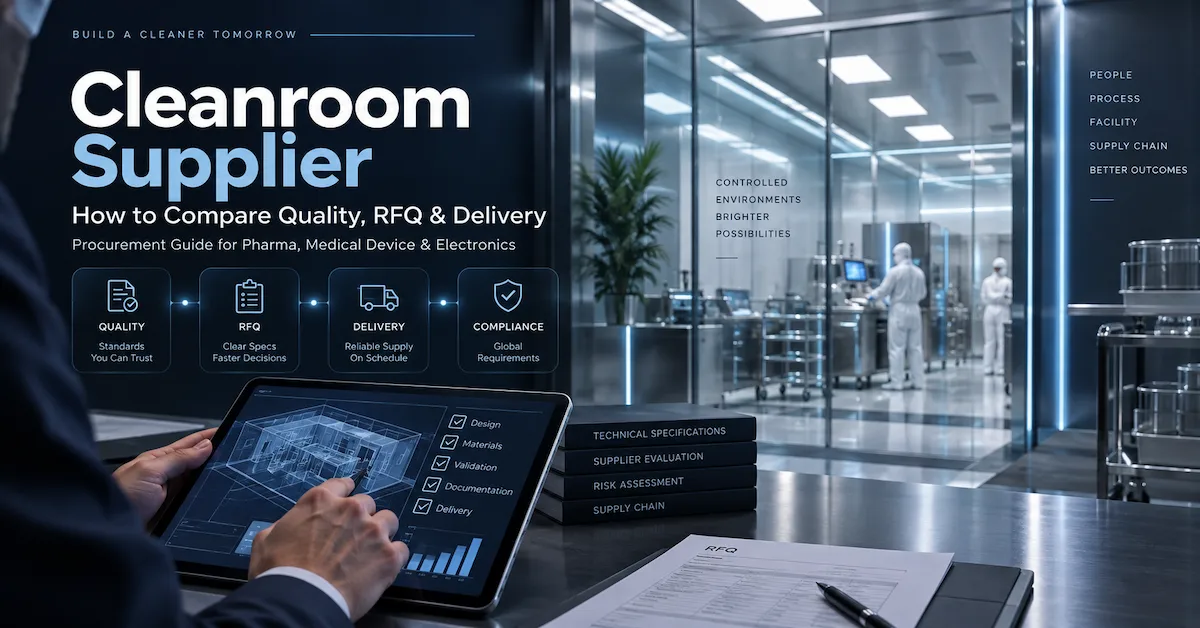
What Does a Cleanroom Supplier Actually Provide?
A cleanroom supplier provides products, technical services, or integrated systems used to create and maintain controlled production and research environments.
However, suppliers operate under different business models.
Some specialize in manufacturing cleanroom panels, doors, ceilings, or furniture. Others distribute filtration equipment and environmental monitoring devices. Engineering-oriented companies may coordinate complete systems, including HVAC design, construction interfaces, and project implementation.
A buyer must determine which model matches the intended purchase.
Four Common Cleanroom Supply Models
| Supplier Model | Typical Scope | Main Advantage | Main Procurement Consideration |
|---|---|---|---|
| Component supplier | Panels, doors, windows, ceilings, selected equipment | Focused product expertise | Buyer manages system interfaces |
| Equipment distributor | Filtration, controls, monitoring, and related equipment | Access to multiple product lines | Confirm original manufacturer and warranty |
| Engineering and integration supplier | Project-specific equipment selection and technical coordination | Better alignment between connected systems | Define design and performance responsibilities |
| Turnkey cleanroom supplier | Coordinated engineering, procurement, installation support, and agreed commissioning activities | Fewer fragmented procurement interfaces | Verify exclusions and contractual boundaries |
No model is automatically superior.
An EPC contractor with completed engineering drawings may prefer specialized equipment suppliers.
A pharmaceutical company building a new controlled production facility may need a broader engineering partner.
A research institution renovating an existing building may require technical coordination between new equipment and existing utilities.
The best choice depends on the project stage and the responsibilities the buyer wants the supplier to assume.
Manufacturer, Supplier, and Contractor: Why the Distinction Matters
These terms are sometimes used interchangeably in marketing materials, but they describe different capabilities.
A manufacturer produces specific equipment or components.
A supplier sells or coordinates the supply of products, which may include goods manufactured by other companies.
A contractor performs defined engineering, installation, or construction activities.
Some organizations combine these functions.
When evaluating a potential partner, ask:
-
Which products are manufactured in-house?
-
Which components are purchased from third-party manufacturers?
-
Who approves technical substitutions?
-
Who prepares engineering drawings?
-
Who is responsible for equipment interfaces?
-
Who coordinates installation and commissioning?
-
Who supplies the final testing documentation?
Answers to these questions often reveal more about practical delivery capability than a general company profile.
For projects requiring coordinated engineering and equipment procurement, reviewing an integrated cleanroom turnkey solution can help buyers understand how individual supply packages fit into a complete facility.
Match the Supplier to Your Industry Before Comparing Prices
The first technical screening question should be:
Has the supplier worked with requirements similar to those of your intended process?
Different industries have different contamination risks, environmental controls, and documentation expectations.
A supplier experienced in general industrial cleanroom construction may not automatically understand every requirement of sterile pharmaceutical manufacturing.
Similarly, a supplier focused on pharmaceutical environments may need additional specialists for electrostatic control or chemical contamination requirements in advanced electronics production.
Pharmaceutical and Biotechnology Facilities
Pharmaceutical cleanrooms may require strict control of particulate and microbiological contamination.
For sterile medicinal products, applicable Good Manufacturing Practice requirements can extend beyond airborne particle classification.
Important procurement considerations include contamination control strategy, personnel movement, material transfer, cleanable surfaces, appropriate room pressure relationships, environmental monitoring, and documented qualification.
For projects subject to EU GMP Annex 1, buyers should involve qualified quality and validation personnel when developing requirements.
Supplier experience should be evaluated against the specific pharmaceutical process rather than a general statement that the company provides GMP cleanrooms.
Medical Device Manufacturing
Medical device manufacturers may require controlled environments for precision assembly, device preparation, packaging, or contamination-sensitive production.
Requirements depend on the device, process, product risks, and applicable quality management obligations.
Buyers should evaluate the supplier's understanding of personnel movement, cleanable construction, monitoring, documentation, and compatibility with production equipment.
A supplier should not automatically apply sterile pharmaceutical requirements to every medical device facility.
Electronics and Semiconductor Facilities
Electronics production may be highly sensitive to airborne particles, environmental instability, or electrostatic discharge.
Some advanced processes also require control of airborne molecular contamination.
The supplier should understand equipment heat loads, airflow organization, maintenance access, and the required environmental stability.
An ISO airborne particle classification alone does not establish acceptable electrostatic or molecular contamination performance.
These parameters must be considered separately when the process requires them.
Food, Cosmetics, and Industrial Processing
Controlled environments can support hygienic operations and contamination reduction in food, cosmetics, and specialized industrial manufacturing.
Important factors include cleanability, material resistance, zoning, maintenance, and process-related environmental requirements.
The appropriate design must follow the product and relevant risks instead of applying an unnecessarily strict cleanliness target without technical justification.
University and Research Facilities
Research laboratories may combine laboratory furniture, analytical equipment, local ventilation, controlled environments, and specialized utilities.
The supplier's ability to coordinate these elements is often more valuable than supplying a single type of equipment.
For projects involving laboratory furniture, ventilation, and supporting systems, buyers may also need an integrated laboratory engineering solution.
Industry-Specific Supplier Evaluation
| Industry | Main Procurement Priority | Important Technical Evidence |
|---|---|---|
| Pharmaceutical manufacturing | Contamination control and documented qualification | Engineering scope, applicable GMP documentation, testing responsibilities |
| Medical device manufacturing | Controlled assembly and cleaning compatibility | Material specifications, environmental design, inspection records |
| Semiconductor manufacturing | Particle control and environmental stability | HVAC design assumptions, filtration specifications, equipment interfaces |
| Electronics production | Particle control, humidity, and ESD requirements | Environmental control proposals, equipment compatibility |
| Food and cosmetics | Hygienic design and maintainable surfaces | Material compatibility, cleaning requirements, construction details |
| Research laboratories | Flexible layouts and coordinated utilities | Technical drawings, equipment integration, project scope |
The most relevant supplier is the one that can translate industry requirements into technically justified products and clearly documented responsibilities.
Prepare a User Requirements Specification Before Contacting Suppliers
A User Requirements Specification, commonly called a URS, is one of the most useful documents in cleanroom procurement.
It describes what the facility needs to achieve.
A URS should not be confused with a supplier's equipment catalog.
The URS identifies required outcomes, operating conditions, constraints, and acceptance expectations. The supplier then develops a technical proposal showing how those requirements can be satisfied.
Without this foundation, different suppliers may quote entirely different solutions.
Information Every Cleanroom URS Should Consider
| Requirement | Buyer Input | Supplier Evaluation |
|---|---|---|
| Application | Manufacturing process and product type | Suitability of proposed solution |
| Location | Country, city, facility conditions | Codes, environmental assumptions, logistics |
| Project type | New construction, renovation, expansion | Construction and integration scope |
| Layout | Room dimensions, available height, drawings | Space planning and installation feasibility |
| Cleanliness | Target classification and required state | Classification and verification strategy |
| Temperature | Operating range and tolerance | HVAC design basis |
| Relative humidity | Target conditions and process sensitivity | Humidity control approach |
| Pressure relationships | Protected and containment zones | Airflow and pressure strategy |
| Personnel flow | Occupancy, gowning, movement | Access and zoning design |
| Material flow | Incoming goods, finished products, waste | Airlocks and transfer arrangements |
| Equipment | Heat load, exhaust, electrical and utility needs | Engineering coordination |
| Testing | Acceptance criteria and required records | Commissioning and testing scope |
Specify Performance Instead of Selecting Products Too Early
A common procurement mistake is requesting a fixed number of fan filter units or a particular wall system before the environmental design is complete.
The buyer may know the required cleanliness level, room dimensions, and production process but not yet know the correct equipment arrangement.
In that situation, the better approach is to request an engineering proposal.
The supplier can then evaluate airflow needs, heat loads, room configuration, and filtration options.
However, technical recommendations should be supported by design assumptions and calculations.
For example, the required number of FFUs cannot be determined from floor area alone without considering the target environment, airflow arrangement, equipment loads, and other project requirements.
Separate Mandatory and Preferred Requirements
Not every project preference has equal importance.
The URS should distinguish:
Mandatory requirements: Conditions that the proposed system must satisfy, such as applicable regulations, critical environmental performance, safety requirements, and defined acceptance criteria.
Preferred requirements: Desirable features that can be evaluated commercially, such as modular expansion, particular access arrangements, or optional monitoring functions.
This distinction prevents unnecessary cost increases and helps suppliers identify acceptable alternatives.
What Products and Systems Should a Cleanroom Equipment Supplier Cover?
A complete cleanroom may include multiple equipment and construction packages.
Some are essential to the basic controlled environment. Others depend entirely on the manufacturing process.
Buyers should request a detailed bill of quantities (BOQ) or equipment schedule rather than accepting a broad description such as "complete cleanroom equipment."
Cleanroom Equipment and Procurement Scope
| System Category | Typical Components | Key Information to Verify |
|---|---|---|
| Cleanroom envelope | Wall panels, ceilings, windows | Materials, finish, joint design, dimensions |
| Access systems | Cleanroom doors, seals, interlocks where required | Air leakage, durability, cleaning compatibility |
| Air-handling systems | AHUs, fans, ductwork, dampers | Design airflow, external pressure, control strategy |
| Filtration | HEPA filters, terminal housings, FFUs | Filter specifications, testing, replacement access |
| Environmental controls | Sensors, pressure controls, temperature and humidity controls | Accuracy, calibration, alarms |
| Monitoring | Particle monitoring and other relevant instruments | Data handling, reporting, maintenance |
| Material transfer | Pass-through systems or application-specific transfer devices | Transfer flow, containment, cleaning |
| Cleanroom furniture | Benches, cabinets, workstations | Materials, cleanability, load requirements |
| Supporting utilities | Electrical, water, gases, exhaust interfaces | Contractual boundaries and coordination |
| Documentation | Drawings, manuals, test records | Completeness, format, language, traceability |
These are common industry product categories, not a statement that every supplier manufactures or stocks every item.
Cleanroom Wall and Ceiling Systems
Wall and ceiling systems must support the intended operating environment.
Evaluation criteria may include surface durability, cleaning compatibility, joint sealing, dimensional accuracy, and maintenance access.
Material specifications should identify the construction rather than relying only on marketing names.
For example, the buyer may need information on panel thickness, core material, finish, edge construction, and sealing methods.
Appropriate material selection depends on the process and applicable building and fire safety requirements.
Filtration and Air-Handling Equipment
Filters are important components, but the complete air-handling system determines how filtered air is delivered to the room.
The supplier should provide sufficient information about airflow capacity, pressure losses, fan operation, control interfaces, and maintenance requirements.
Filter efficiency should be supported by appropriate product documentation.
The buyer should also confirm whether installed filter leakage testing is included after installation.
Cleanroom Furniture and Accessories
Furniture can affect cleaning access, workflow, and equipment placement.
Buyers should evaluate material compatibility, construction details, service connections, and space requirements.
For integrated laboratory projects, some facilities require combinations of laboratory workstations and cleanroom-compatible furniture.
You can review XurenClean's current laboratory and cleanroom product categories and request product-specific documentation for the proposed application.
Avoid Ordering Unnecessary Equipment
Not every cleanroom requires an air shower, automated pass box, or advanced continuous monitoring system.
Equipment selection should be based on contamination risks, production workflow, applicable standards, and operational requirements.
Unnecessary equipment can increase maintenance responsibilities without providing meaningful process value.
A competent supplier should explain why each major component is included.
How to Verify Cleanroom Supplier Quality and Technical Documentation
A supplier's product photographs and marketing claims cannot replace engineering evidence.
For B2B procurement, the most useful information is often found in technical submittals, manufacturing records, inspection plans, and agreed acceptance documentation.
Product Documentation Checklist
Request the following where applicable:
-
Product datasheets identifying relevant performance and construction details.
-
Approved materials and component specifications.
-
General arrangement drawings and detailed manufacturing drawings.
-
Bills of materials identifying major equipment and components.
-
Relevant certificates or test reports for specified products.
-
Quality inspection procedures and applicable records.
-
Electrical and control interface information.
-
Installation and maintenance instructions.
-
Spare parts and consumables information.
-
Warranty scope and after-sales contact procedures.
The required evidence should correspond to the actual purchase.
A wall panel supplier does not necessarily need to provide a complete HVAC commissioning report. A system integrator responsible for environmental performance may require a much broader documentation package.
Verify the Origin of Critical Components
Some suppliers manufacture selected products in-house while sourcing other components from specialist manufacturers.
This is common in industrial engineering.
The concern is not whether every item is manufactured under one roof.
The concern is whether component origin, specifications, substitutions, quality control, and warranties are adequately managed.
For important components, ask for identification of the original manufacturer or an agreed equivalent specification.
If alternative components are permitted, define the approval process before production.
A supplier should not substitute a critical component without demonstrating that the replacement meets the contractual requirements.
Review Manufacturing and Inspection Controls
Depending on the products being purchased, important inspections may include:
-
Incoming material checks.
-
Dimensional inspection.
-
Fabrication and assembly checks.
-
Surface finish examination.
-
Functional checks for applicable equipment.
-
Packing and shipping inspection.
Buyers should ask which checks are routinely performed and which require a project-specific inspection plan.
Certification Claims Require Verification
A company may display quality management or construction-related certificates.
These can be useful indicators, but they must be interpreted correctly.
Check the certificate holder, issuing organization, certification scope, validity, and relevance to the contracted activities.
For example, a quality management system certificate does not independently prove that a cleanroom installation achieves a specified ISO airborne particle classification.
Likewise, a supplier's ability to manufacture cleanroom components does not by itself establish qualification for every regulated application.
Which Cleanroom Standards Matter During Supplier Evaluation?
Standards should be treated as verifiable technical requirements, not decorative phrases on a quotation.
Different ISO 14644 standards address different stages and aspects of cleanroom performance.
| Standard | Main Subject | Procurement Application |
|---|---|---|
| ISO 14644-1:2015 | Air cleanliness classification by particle concentration | Defining and verifying airborne particle cleanliness |
| ISO 14644-2:2015 | Monitoring related to airborne particle cleanliness | Developing an appropriate monitoring plan |
| ISO 14644-3:2019 | Cleanroom test methods | Defining applicable performance tests |
| ISO 14644-4:2022 | Design, construction, and start-up | Supporting project requirements and delivery planning |
| ISO 14644-5:2025 | Cleanroom operations | Personnel, cleaning, maintenance, and operational controls |
The applicable editions and requirements should be confirmed during project specification.
Does ISO Classification Mean the Cleanroom Is Fully Qualified?
No.
ISO 14644-1 defines classification based on airborne particle concentration within its specified scope.
It does not establish that the room meets every possible process, microbiological, safety, or regulatory requirement.
The procurement documents must specify the required classification condition and test arrangement.
ISO 14644-3 recognizes testing under different occupancy states, including as-built, at-rest, and operational conditions.
What About Pharmaceutical GMP?
For sterile medicinal products subject to European GMP requirements, Annex 1 addresses a broader contamination control framework.
The project may require additional environmental, microbiological, procedural, and qualification controls.
Consequently, a claim that a room is "ISO classified" must not be presented as automatic proof of complete GMP compliance.
A pharmaceutical buyer should involve the relevant quality, engineering, and validation teams in defining and reviewing requirements.
How to Use Standards in a Purchase Contract
Identify:
-
The specific standard and edition.
-
Which requirements apply to the purchase.
-
The intended test methods.
-
Test conditions.
-
Acceptance criteria.
-
Required records.
-
Organizations responsible for testing.
-
Procedures for resolving failed tests.
A general sentence such as "All equipment complies with international standards" is too vague for a complex engineering purchase.
How to Audit a Cleanroom Supplier Before Placing an Order
Supplier evaluation should go beyond reviewing a website.
A structured audit can help confirm whether the organization has the technical and operational capability required for the purchase.
The depth of the audit should be proportional to project risk.
A small furniture order may require a product and production review. A regulated facility project may require a more comprehensive technical, quality, and contractual evaluation.
Ten Supplier Qualification Questions
| Question | Why It Matters |
|---|---|
| What parts of the project are manufactured in-house? | Clarifies direct manufacturing control |
| Which components come from external manufacturers? | Identifies critical supply-chain dependencies |
| Can you provide relevant project references? | Helps assess application experience |
| Who prepares and approves engineering drawings? | Establishes design responsibility |
| How are material substitutions controlled? | Reduces specification and performance risk |
| What inspections occur before shipment? | Clarifies factory quality control |
| What is included in your technical documentation package? | Supports installation and maintenance |
| Who coordinates installation and commissioning? | Defines responsibility after delivery |
| How are nonconformities and corrective actions managed? | Evaluates problem resolution |
| What after-sales support is available in our region? | Establishes realistic support expectations |
Factory Visits and Remote Audits
Where appropriate, a factory visit can help buyers review production conditions, manufacturing equipment, inspection practices, and project coordination.
For international buyers, a remote audit may be a practical initial step.
A useful remote review may involve a video meeting, product documentation, production photographs, technical discussions, and inspection records.
For critical equipment, the buyer may also consider independent pre-shipment inspection.
However, the inspection company, scope, sampling plan, and acceptance criteria should be agreed before the service is arranged.
Supplier Red Flags
Be cautious when a supplier:
-
Refuses to identify important technical exclusions.
-
Cannot explain the basis of its proposed equipment configuration.
-
Provides conflicting technical specifications.
-
Changes major component brands without an approval procedure.
-
Makes universal regulatory compliance claims without appropriate evidence.
-
Promises an unusually short schedule without reviewing engineering requirements.
-
Cannot identify who is responsible for installation or final performance testing.
These warning signs do not always prove poor capability, but they justify further investigation before contract award.
How to Prepare a Cleanroom RFQ That Attracts Accurate Quotations
An effective request for quotation should help qualified suppliers understand the actual engineering and purchasing task.
If the RFQ only states "We need an ISO Class 7 cleanroom, please quote your best price," suppliers must make assumptions about almost every important detail.
That often results in inconsistent prices and incomplete proposals.
Cleanroom RFQ Checklist
| RFQ Field | Information to Include |
|---|---|
| Buyer information | Company, contact person, destination |
| Project application | Pharmaceutical, medical device, electronics, or other |
| Purchase type | Equipment-only, materials, engineering package, turnkey |
| Project status | Concept, detailed design, renovation, expansion |
| Facility dimensions | Area, height, layout drawings |
| Classification requirements | Target class and relevant occupancy state |
| Environmental conditions | Temperature, humidity, pressure requirements |
| Major process equipment | Dimensions, heat loads, service connections |
| Product scope | Panels, doors, filtration, HVAC, controls, furniture |
| Technical standards | Applicable editions and project specifications |
| Documentation | Drawings, test reports, manuals, certificates |
| Quality inspections | FAT, third-party inspection, agreed hold points |
| Delivery | Destination, Incoterms rule, packing requirements |
| Installation | Local contractor, supplier support, or agreed installation scope |
| Acceptance | SAT, classification testing, commissioning records |
| Commercial terms | Currency, payment milestones, quotation validity |
| Schedule | Required delivery and project milestones |
Sample Cleanroom Supplier Inquiry
The following short RFQ message can be adapted for a real project.
We are planning a controlled-environment manufacturing facility for medical device production. We would like to obtain a technical proposal and quotation for cleanroom-related systems.
Our preliminary requirements include the project floor area, intended operating process, target cleanliness classification, environmental conditions, and anticipated installation schedule. Architectural drawings and an equipment list are available for technical review.
Please clarify your proposed supply scope, engineering responsibilities, major component specifications, manufacturing lead time, delivery arrangements, documentation package, installation support, and commissioning or testing responsibilities.
We would also appreciate information about applicable quality controls and any exclusions from your quotation.
This message is more useful than requesting a price without technical context.
For an actual project, add the required dimensions, operating conditions, and commercial information.
Should You Request a Budgetary Quote or a Final Quote?
The answer depends on project maturity.
A budgetary quotation may be appropriate when the facility concept is still being developed.
It should clearly state assumptions, exclusions, and the level of cost accuracy that the supplier is prepared to support.
A final commercial quotation should be based on sufficiently developed drawings, specifications, equipment schedules, and agreed responsibilities.
Do not use a preliminary price as though it were a fixed-price commitment for an undefined engineering scope.
If you are preparing a project-specific RFQ, XurenClean's contact page provides a route for submitting your application, location, required systems, and expected schedule for initial review.
How to Compare Cleanroom Supplier Quotations Fairly
Price comparison is only meaningful when the quotations describe equivalent scopes.
A quotation that excludes HVAC, controls, installation, and performance testing should not be directly compared with one that includes those services.
Normalize the Bid Scope
Before reviewing total prices, create a comparison sheet showing what each supplier includes.
| Procurement Item | Supplier A | Supplier B | Supplier C |
|---|---|---|---|
| Design drawings | Included | Included | Excluded |
| Wall and ceiling systems | Included | Included | Included |
| Doors and windows | Included | Included | Included |
| HVAC equipment | Included | Excluded | Optional |
| Filtration equipment | Included | Included | Included |
| Environmental controls | Included | Optional | Excluded |
| Installation support | Included | Optional | Excluded |
| Commissioning assistance | Included | Excluded | Optional |
| Classification testing | Third-party coordination | Excluded | Excluded |
| Technical manuals | Included | Included | To be confirmed |
Illustrative comparison only. The entries do not represent quotations from actual suppliers.
The example shows why total prices may vary even when all proposals are described as cleanroom solutions.
Use a Weighted Supplier Evaluation Matrix
For complex B2B purchases, evaluate suppliers with a consistent methodology.
| Evaluation Criterion | Suggested Weight |
|---|---|
| Technical understanding and system integration | 20% |
| Applicable testing and quality evidence | 20% |
| Product and material specification transparency | 15% |
| Contractual scope and quotation clarity | 15% |
| Delivery and project management | 10% |
| After-sales support and maintenance | 10% |
| Total evaluated procurement cost | 10% |
| Total | 100% |
This is an illustrative evaluation framework, not an official ISO scoring model.
Weights should reflect the actual project's risks and priorities.
For example, a tightly regulated pharmaceutical project might allocate more weight to documentation and qualification support.
A distributor purchasing standardized components may place greater emphasis on product conformity, availability, and logistics.
How Should Scores Be Assigned?
Scores should be based on evidence rather than subjective impressions.
A supplier receiving a high score for documentation should provide the required drawings, specifications, and applicable quality records.
A supplier receiving a high score for delivery should provide a credible schedule with identified dependencies.
Where evidence is missing, classify the item as requiring clarification rather than assuming compliance.
This creates a more defensible procurement decision.
What Affects Cleanroom Supplier Pricing?
Cleanroom supply costs depend on the technical requirements and contractual boundaries.
It is difficult to establish meaningful pricing from area alone.
Major cost factors include:
-
Number and dimensions of rooms.
-
Required cleanliness classifications.
-
Construction materials and finishes.
-
HVAC and filtration capacity.
-
Temperature and humidity tolerances.
-
Pressure-control complexity.
-
Environmental monitoring requirements.
-
Utility distribution and interfaces.
-
Project-specific manufacturing.
-
Inspection and documentation requirements.
-
Shipping and installation responsibilities.
-
Testing and commissioning scope.
Purchase Price vs. Landed Cost
For overseas procurement, equipment price is not necessarily the final cost of receiving usable equipment at the project site.
Depending on the contract and destination, buyers may need to consider export packaging, freight, insurance, customs procedures, import duties, local delivery, and unloading.
The extent to which these are included depends on the agreed commercial terms.
Purchase Price vs. Installed Cost
A supplier may quote equipment ready for shipment.
However, the buyer may still need to pay for local labor, installation materials, electrical connections, testing, and site coordination.
These expenses should be included when comparing alternatives.
Purchase Price vs. Lifecycle Cost
Operating expenses can significantly affect a controlled-environment facility.
Important considerations include fan energy consumption, cooling demand, replacement filters, environmental monitoring, cleaning, periodic testing, maintenance access, and downtime during repairs.
An equipment package with a lower purchase price may not always provide the lowest long-term cost.
The correct comparison should reflect the intended operating life, maintenance strategy, and required performance.
The goal is not to minimize every individual equipment cost. It is to obtain a technically suitable system with a transparent and manageable total cost of ownership.
International Cleanroom Procurement: Shipping, Incoterms, and Delivery Risks
International sourcing introduces responsibilities that may not be obvious in the initial quotation.
These include transportation, export and import procedures, packaging, documentation, and coordination with local contractors.
Understand the Agreed Incoterms Rule
Incoterms® 2020, published by the International Chamber of Commerce, provides internationally recognized rules for allocating certain delivery responsibilities, costs, and risks between buyers and sellers.
Commonly encountered terms include EXW, FOB, and DAP, although the appropriate term depends on the transaction and transport arrangements.
Buyers should not assume that all quotations with the same equipment price include the same shipping responsibility.
The selected rule should be appropriate for the transport mode and identify the named place or port.
Importantly, Incoterms rules do not replace the complete purchase contract or define every issue, such as equipment performance, payment arrangements, intellectual property, or warranty obligations.
Packaging Requirements
Cleanroom components can be sensitive to damage during handling and transportation.
Packaging should consider product dimensions, surface finishes, moisture exposure, handling methods, and the transport route.
For example, long wall panels and fragile components may require different protective arrangements.
Buyers should confirm:
-
Packaging materials and protection methods.
-
Package identification and numbering.
-
Gross and net weight information.
-
Handling and lifting instructions.
-
Protection against expected shipping conditions.
-
Inspection procedures for damaged packages.
-
Any special destination-specific packing requirements.
Shipping Documents and Customs Coordination
Required documents depend on the destination and the transaction.
They may include commercial invoices, packing lists, transport documents, certificates of origin where applicable, and product-related technical documentation.
The buyer should coordinate with the relevant logistics and customs professionals to determine actual requirements.
Do not assume that a supplier's experience with one destination automatically resolves the requirements of another country.
Delivery and Installation Are Different Obligations
Delivery to a port or construction site does not automatically include unloading, installation, system connection, commissioning, or testing.
The contract should specify the point at which the supplier's delivery responsibilities end.
For larger projects, appointing a responsible interface coordinator can help prevent disputes between equipment suppliers, local installers, and engineering contractors.
How to Manage Cleanroom Project Lead Time and Delivery Milestones
Production time is only one element of the overall project schedule.
For complex cleanroom projects, the critical path may include design approval, manufacturing, equipment procurement, building readiness, international transportation, installation, and testing.
Recommended Delivery Milestones
Milestone 1: Technical requirements confirmed
The buyer and supplier agree on the project scope, performance requirements, documentation expectations, and major exclusions.
Milestone 2: Engineering drawings approved
Relevant layouts, interface drawings, and equipment specifications are reviewed and approved before manufacturing begins.
Milestone 3: Procurement and manufacturing released
The supplier confirms the production basis and identifies important component availability or procurement dependencies.
Milestone 4: Quality inspection completed
The required manufacturing inspections and applicable acceptance activities are completed.
Milestone 5: Shipment authorized
The buyer and supplier confirm the packing, shipping documentation, and required release approvals.
Milestone 6: Site delivery and installation coordination
Products arrive under the agreed delivery arrangements and are checked against the packing records and project requirements.
Milestone 7: Commissioning and acceptance
The responsible parties perform the agreed testing and handover procedures.
Why Drawing Approval Is a Critical Hold Point
Changes after manufacturing begins can affect cost and lead time.
Examples include revised wall dimensions, altered door locations, additional equipment penetrations, or changes to HVAC routing.
A formal drawing approval process helps reduce uncontrolled changes.
Important deviations should be evaluated through an agreed change-control procedure.
The buyer should understand how variations affect price, manufacturing schedules, and project responsibilities.
Ask for a Realistic Schedule
A credible schedule identifies major activities and dependencies.
It should not simply promise a fixed number of days regardless of project complexity.
According to XurenClean's published project FAQs, manufacturing and cleanroom project timing depend on equipment, materials, scope, approvals, shipping arrangements, and site conditions.
Project-specific milestones are established after requirements and scope are confirmed.
FAT, SAT, and Cleanroom Acceptance: What Must Be Verified?
One of the most important supplier evaluation questions is:
How will the buyer determine whether the contracted products and systems are acceptable?
The answer depends on the actual supply scope.
Factory Acceptance Testing
Factory Acceptance Testing (FAT) is used when specified equipment or systems require inspection or functional testing before shipment.
Depending on the equipment, FAT may include visual inspection, dimensional verification, control functions, electrical checks, or other agreed tests.
Not every individual cleanroom component requires the same FAT procedure.
The inspection and testing plan should correspond to the technical risks and contractual requirements.
Site Acceptance Testing
Site Acceptance Testing (SAT) generally concerns equipment or systems after delivery and installation.
Tests may focus on installed condition, functional operation, interfaces, controls, and agreed performance requirements.
The precise SAT scope must be established in the contract.
Cleanroom Classification Testing
Cleanroom particle classification should follow the applicable requirements of ISO 14644-1.
Relevant test methods may be selected with reference to ISO 14644-3.
Depending on the project, testing may also consider installed filter leakage, airflow, pressure differences, environmental conditions, and other specified parameters.
The scope must define:
-
Required testing condition.
-
Measurement locations and methods.
-
Acceptance criteria.
-
Responsible testing organization.
-
Reporting requirements.
-
Corrective-action procedures.
Who Is Responsible for Validation?
Commissioning, classification, qualification, and regulated process validation are not interchangeable.
A supplier may coordinate some testing activities while an independent specialist or the owner's qualified team performs others.
For pharmaceutical applications, the owner's quality system and applicable regulatory requirements influence qualification responsibilities.
Buyers should not interpret the phrase "turnkey cleanroom" as an automatic guarantee that all regulatory validation activities are included.
Cleanroom Handover Document Checklist
| Document | Purpose |
|---|---|
| Approved design drawings | Establishes the agreed technical basis |
| As-built drawings | Records the installed configuration |
| Equipment schedule | Identifies supplied components |
| Material and component records | Supports traceability |
| Manufacturing inspection records | Documents applicable factory checks |
| FAT reports | Records agreed factory testing |
| Installation inspection records | Documents installed work |
| SAT and commissioning records | Supports functional acceptance |
| Cleanroom test reports | Provides applicable environmental performance evidence |
| Operation and maintenance manuals | Supports ongoing use and service |
| Warranty and support documentation | Defines post-delivery responsibilities |
The required package should be agreed before ordering.
Cleanroom Procurement Risk Register: Problems Buyers Should Prevent
A simple risk register can help both technical and purchasing teams identify unresolved issues.
| Procurement Risk | Possible Consequence | Recommended Preventive Action |
|---|---|---|
| Undefined supply scope | Unexpected additional costs | Itemized BOQ and responsibility matrix |
| Incomplete URS | Incorrect configuration | Technical requirement review |
| Unapproved component substitutions | Specification mismatch | Formal substitution approval |
| Missing drawings | Installation conflicts | Design review and approval milestones |
| Unclear shipping responsibility | Freight and customs disputes | Explicit delivery terms and named location |
| Poor packaging | Transportation damage | Agreed packing specifications |
| Unclear testing responsibility | Delayed acceptance | Written test scope and acceptance criteria |
| Incomplete documentation | Maintenance and qualification difficulties | Contractual document register |
| Weak after-sales arrangements | Extended operational interruption | Defined support and spare parts arrangements |
The objective is not to eliminate every possible uncertainty.
It is to identify important risks early enough that responsibilities and responses can be agreed.
For international cleanroom procurement, this is especially valuable because equipment suppliers, freight providers, installers, and facility owners may operate in different jurisdictions.
Why Consider XurenClean as a Cleanroom Engineering and Supply Partner?
XurenClean, operated by Guangzhou Xuren Purification Equipment Engineering Co., Ltd., provides integrated laboratory and cleanroom engineering solutions.
According to its published company information, its related engineering activities date back to 2008.
The company describes engineering and project management capabilities supported by in-house manufacturing of laboratory and cleanroom-related furniture.
Its business scope covers laboratory and cleanroom solutions for research, healthcare, pharmaceutical, electronics, and advanced manufacturing applications.
Project-Oriented Engineering Support
Rather than focusing only on individual components, XurenClean describes a coordinated service model involving:
-
Conceptual design.
-
Technical integration.
-
Manufacturing production.
-
Project delivery.
-
Installation support.
-
Commissioning and validation coordination.
This approach may be relevant to buyers who need to coordinate multiple equipment and engineering interfaces.
The exact contractual responsibilities, product supply scope, installation support, and testing services should be defined for each project.
Customized Laboratory and Cleanroom Solutions
XurenClean's published cleanroom solution portfolio addresses cleanliness, temperature, humidity, room pressure, and airflow control for controlled production and research environments.
The company's wider service portfolio includes laboratory engineering and supporting environmental systems.
For example, a manufacturing project may require coordination with a pure water system or exhaust gas treatment solution, depending on the actual process.
These services should be evaluated as separate or integrated project packages according to technical requirements.
Manufacturing and Quality Control
XurenClean describes internal manufacturing capabilities for laboratory and cleanroom furniture, together with material inspection, production control, assembly checks, and pre-shipment inspections.
Prospective buyers should confirm the exact manufacturing scope and available specifications for the products they intend to purchase.
The company's About Us page provides information about its engineering background, operations, and service capabilities.
International Project Experience
XurenClean's published project portfolio includes laboratory and related engineering work across several international markets.
This experience can be useful when discussing project logistics, technical communication, and equipment coordination.
For procurement qualification, buyers should request relevant project references and supporting evidence that match their particular application.
Project-specific cleanliness classification reports, customer references, and detailed performance data should be reviewed where available and authorized for disclosure.
A Practical Starting Point for Buyers
Whether the purchase involves selected components or an integrated facility solution, the first step is to establish the intended application and scope.
XurenClean's technical team can review submitted project information and discuss the appropriate next steps.
To begin, request a cleanroom project discussion with your preliminary drawings, process requirements, target environmental conditions, and expected schedule.
Final Cleanroom Supplier Selection Checklist
Before approving a cleanroom purchase, use the following decision checklist.
| Final Procurement Check | Required Action |
|---|---|
| Application clearly defined | Confirm the intended manufacturing or research process |
| URS reviewed | Check critical performance requirements |
| Supplier model understood | Identify manufacturer, distributor, integrator, or contractor roles |
| Product scope confirmed | Review the BOQ and equipment schedule |
| Technical documents available | Verify specifications and required drawings |
| Component sources identified | Confirm critical manufacturers and substitution procedures |
| Quality plan agreed | Define inspection activities and acceptance evidence |
| Delivery responsibilities clear | Confirm contractual terms, packaging, and logistics |
| Installation responsibilities clear | Identify site work and interface owners |
| Testing responsibilities agreed | Confirm FAT, SAT, classification, and applicable qualification scope |
| Commercial exclusions reviewed | Identify additional costs and responsibilities |
| After-sales support clarified | Confirm technical assistance, warranty, and maintenance information |
A supplier should be selected only after critical technical and contractual ambiguities have been resolved.
For complex projects, it may be useful to conduct a joint review involving procurement, engineering, quality assurance, and facility management representatives.
This helps ensure that the selected solution is commercially acceptable and technically appropriate.
Frequently Asked Questions About Cleanroom Suppliers
1. What should I look for when choosing a cleanroom supplier?
Look for relevant industry experience, a clearly defined supply scope, verifiable technical specifications, quality control procedures, and realistic delivery arrangements.
Ask whether the supplier manufactures the requested products directly or sources them from external manufacturers.
For complete facility projects, review engineering coordination, installation responsibilities, and environmental testing requirements.
The best supplier is one that can provide appropriate evidence for the contracted work and explain how its proposed solution meets your application.
2. Is a cleanroom supplier the same as a cleanroom manufacturer?
Not necessarily.
A manufacturer produces specific cleanroom components or equipment, while a supplier may sell products from multiple manufacturers.
Some suppliers also provide engineering, system integration, and project management services.
The distinction matters because buyers must know who controls manufacturing quality, component selection, technical changes, warranties, and performance testing.
Ask for a responsibility matrix before placing a substantial order.
3. Can I buy cleanroom equipment directly from a supplier in China?
Yes, international buyers can source cleanroom equipment and related products from suppliers in China, subject to applicable trade, product, customs, and destination requirements.
However, buyers should verify specifications, manufacturing responsibilities, inspection procedures, shipping terms, and documentation.
For project-specific systems, technical coordination is especially important.
Overseas procurement should include a clear agreement covering product conformity, delivery, installation interfaces, testing, and after-sales support.
4. How can I verify a cleanroom supplier's quality?
Begin by reviewing product datasheets, manufacturing drawings, material specifications, and inspection procedures.
Where applicable, request sample inspection records and evidence of relevant component testing.
For substantial purchases, consider a factory visit or independent inspection.
Certificates should be checked for scope and validity.
Do not rely solely on company marketing materials or assume that a management system certificate proves cleanroom performance.
5. What is the difference between equipment supply and a turnkey cleanroom project?
Equipment supply usually focuses on defined products or components.
A turnkey arrangement coordinates a broader agreed project scope, potentially involving engineering design, equipment procurement, installation, commissioning, and selected testing activities.
However, the meaning of turnkey can vary between contracts.
Buyers should request explicit inclusions, exclusions, responsibility allocations, and acceptance conditions before making a comparison.
6. What should be included in a cleanroom supplier quotation?
A useful quotation should identify major components, specifications, quantities, pricing, delivery assumptions, documentation, and commercial terms.
For engineered projects, it should also clarify design responsibilities, installation interfaces, commissioning support, and testing exclusions.
An itemized quotation makes supplier comparison easier.
The quotation should reference the agreed technical requirements and explain any deviations or proposed alternatives.
7. Can a cleanroom supplier guarantee ISO 14644 compliance?
A supplier may contract to deliver a system designed to achieve specified environmental performance.
However, actual airborne particle classification must be demonstrated under appropriate testing conditions using applicable procedures.
Buyers should define the required classification, occupancy state, testing method, acceptance criteria, and responsible testing organization.
A marketing claim alone is not evidence that the finished facility meets the specified class.
8. How do I reduce risk when importing cleanroom components?
Use an approved technical specification, a detailed purchase agreement, an inspection plan, and clearly defined shipping responsibilities.
Confirm packaging, documentation, commercial terms, and the destination.
For critical equipment, consider pre-shipment inspection and establish procedures for damage or nonconformity.
Also clarify who will handle local installation, system integration, and acceptance testing.
These steps reduce avoidable disputes and delays.
9. What is the difference between FAT and SAT in cleanroom procurement?
Factory Acceptance Testing examines specified equipment or systems before shipment, using agreed inspections or functional tests.
Site Acceptance Testing occurs after delivery and installation and evaluates the installed condition or operation according to the contract.
Neither term automatically means that a complete cleanroom has passed every required classification or regulatory qualification activity.
Buyers should specify each test and the associated responsibilities.
10. What information should I send XurenClean to request a quotation?
Provide your project location, industry, intended process, room dimensions, required cleanliness level, temperature and humidity targets, major equipment, and expected schedule.
Include architectural drawings and a preliminary URS if available.
Explain whether you need equipment supply, cleanroom engineering, installation support, or a coordinated project solution.
You can submit these details through the XurenClean contact page to begin a project-specific technical discussion.
Conclusion
Selecting a reliable cleanroom supplier requires comparing technical specifications, product quality evidence, contractual responsibilities, delivery arrangements, and total procurement costs. A clear URS, itemized RFQ, documented inspections, and agreed acceptance criteria help buyers avoid expensive surprises.
For pharmaceutical, medical device, electronics, and research facilities, choose a partner whose capabilities match your actual process requirements. To discuss your equipment needs or integrated engineering project, contact XurenClean for a tailored cleanroom quotation.