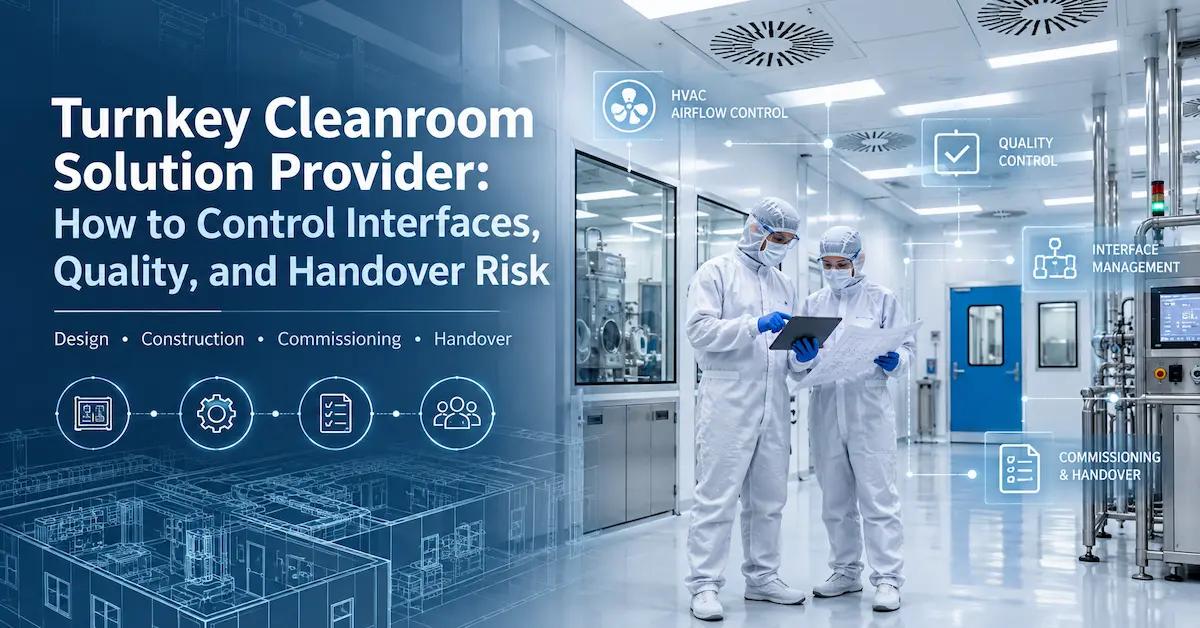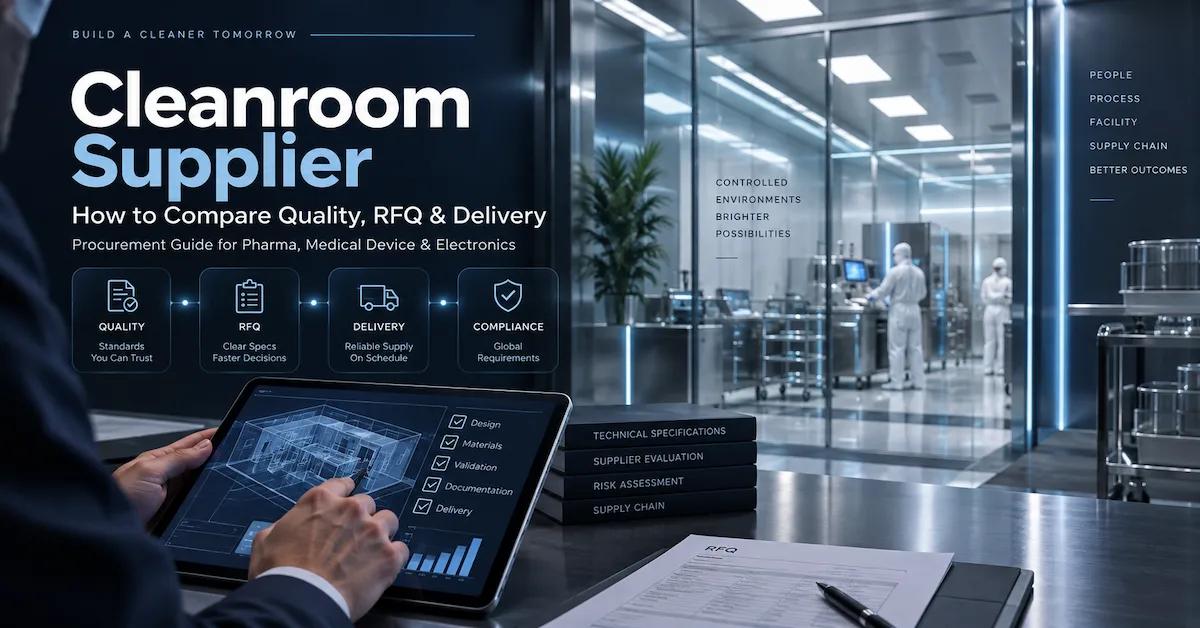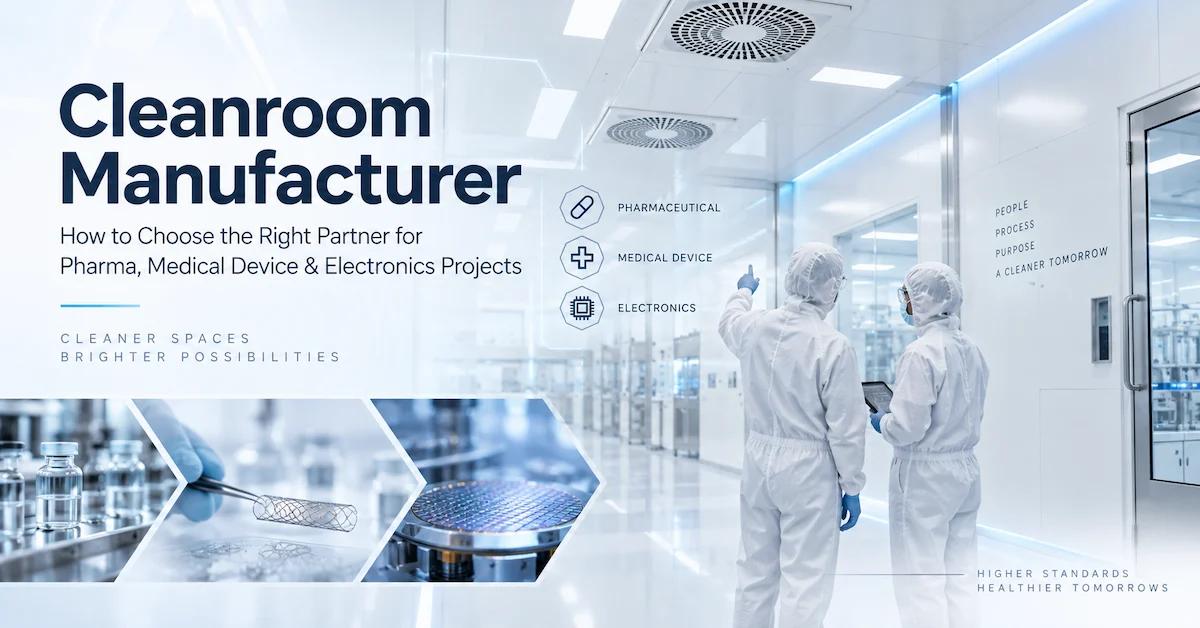

Selecting a turnkey cleanroom solution provider is not simply a matter of comparing cleanroom panels, HEPA filters, or equipment prices. The right provider should coordinate the relationship between process requirements, room layout, HVAC, utilities, materials, construction, commissioning, and final acceptance.
For pharmaceutical, medical device, electronics, semiconductor, biotechnology, healthcare, and research facilities, the main purchasing risk is usually not one defective component. It is the lack of coordination between different systems and contractors. A qualified turnkey provider helps reduce this risk by connecting design, manufacturing, delivery, installation support, commissioning, and validation within one project framework.
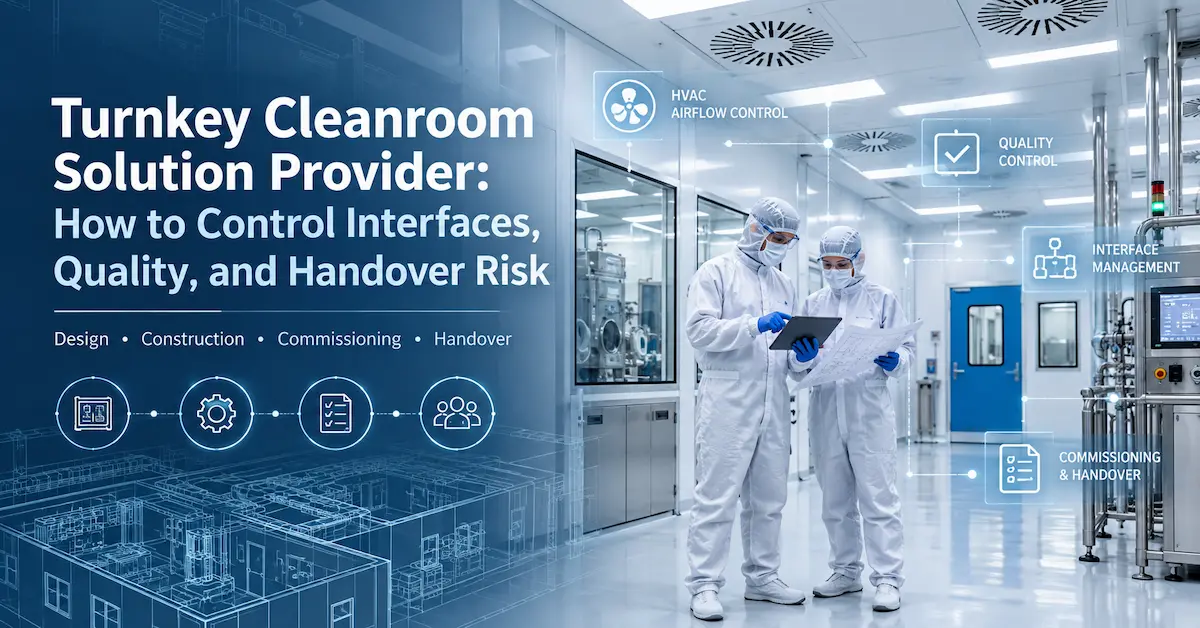
What Does a Turnkey Cleanroom Solution Provider Actually Do?
A turnkey cleanroom solution provider manages or coordinates multiple work packages required to create a controlled environment. The exact scope varies by contract, so buyers should request a clear responsibility matrix before approving a quotation.
| Project area | What the provider should coordinate |
|---|---|
| Process requirements | Product exposure, personnel flow, material flow, equipment heat load, contamination risks |
| Cleanroom planning | Room layout, zoning, cleanliness targets, pressure relationships, access routes |
| HVAC integration | Air changes, filtration, temperature, humidity, pressure cascade, airflow direction |
| Utilities | Electrical power, process water, pure water, gases, vacuum, drainage, data and controls |
| Cleanroom construction | Panels, ceilings, doors, flooring, sealing, finishes and installation interfaces |
| Product and equipment | Cleanroom furniture, workstations, storage, transfer equipment and process interfaces |
| Commissioning | System startup, balancing, environmental testing and corrective actions |
| Handover | As-built drawings, inspection records, operating documents and validation coordination |
A supplier that only manufactures equipment may not be responsible for the performance of the complete facility. Buyers should therefore distinguish between equipment supply, design support, construction, and a true cleanroom turnkey solution.
Which Buyers Need a Turnkey Delivery Model?
A turnkey approach is suitable when the project contains several connected engineering systems and the owner wants to reduce coordination between separate suppliers.
Typical users include:
- Pharmaceutical manufacturers developing GMP production or research areas
- Medical device companies requiring controlled assembly and packaging spaces
- Biotechnology companies building laboratories or process areas
- Electronics and semiconductor manufacturers requiring particle control
- Universities and research institutes developing new laboratories
- Hospitals planning operating rooms and supporting clinical spaces
- Food and cosmetics manufacturers requiring hygienic production environments
- EPC contractors that need an engineering and equipment partner
- International buyers that need manufacturing, export delivery, and installation support
A turnkey model may be less suitable when the buyer already has completed engineering drawings, an appointed local contractor, and a fully defined equipment package. In that situation, an equipment-only or manufacturing-only contract may be more efficient.
The key question is not whether a company uses the word “turnkey.” The key question is which interfaces the company actually owns, coordinates, documents, and supports.
Eight Questions to Ask Before Choosing a Provider
1. Who owns the design basis?
The design basis should define the process, room functions, cleanliness requirements, temperature and humidity targets, pressure relationships, equipment loads, personnel flow, material flow, and applicable regulations.
If the design basis is incomplete, later changes can affect room sizes, HVAC capacity, electrical loads, construction materials, and project cost.
2. Which systems are included?
A complete proposal should state whether it includes:
- Cleanroom architecture
- HVAC and air handling
- Filtration
- Electrical systems
- Process utilities
- Pure water
- Exhaust and environmental treatment
- Cleanroom furniture
- Controls and monitoring
- Installation
- Testing and validation support
For laboratory projects, the scope may also include laboratory turnkey solutions, laboratory furniture, intelligent ventilation, utilities, and installation coordination.
3. How are HVAC and process interfaces controlled?
HVAC performance depends on more than selecting an air handling unit. The provider should explain how airflow, pressure, heat load, equipment exhaust, door openings, personnel movement, and room usage affect the final design.
A pharmaceutical filling area, a medical device assembly room, and an electronics cleanroom may have different environmental priorities. The cleanroom class should be selected after the process and contamination risks are understood.
4. Who performs local installation?
For international projects, the contract should identify:
- Who supplies installation drawings
- Who supervises local installation
- Who provides site training
- Who performs testing
- Who corrects installation defects
- Who coordinates local subcontractors
- Who signs the final acceptance documents
A company may provide installation support without directly employing local construction teams. This distinction should be clear before commercial approval.
5. What quality documents are available?
Buyers should request a quality plan covering:
- Material inspection
- Component inspection
- Manufacturing checks
- Assembly inspection
- Dimensional verification
- Functional testing
- Pre-shipment inspection
- Packaging and labeling
- Site inspection
- Commissioning records
The provider should also identify current certificates, qualification scope, and validity dates. Certificate claims should always be checked against the original documents.
6. How are changes controlled?
Cleanroom projects often change after equipment layouts, utility loads, or regulatory requirements are updated. A professional provider should have a documented change-control process.
The proposal should explain how changes affect:
- Cost
- Schedule
- Drawings
- Materials
- Equipment
- Testing
- Final acceptance
7. How is lead time calculated?
There is no universal cleanroom delivery time. The schedule depends on project area, cleanliness class, scope, material selection, equipment quantity, approvals, site readiness, installation arrangements, and shipping conditions.
The provider should issue a project schedule after the technical scope and order are confirmed. Avoid suppliers that promise a fixed delivery date without reviewing the project information.
8. What happens during handover?
Handover should include more than a completed room. Buyers should confirm whether the final package includes:
- As-built drawings
- Equipment lists
- Operation and maintenance information
- Inspection records
- Test results
- Cleaning instructions
- Warranty details
- Training records
- Validation coordination documents
Technical Scope a Provider Should Coordinate
HVAC and environmental control
A cleanroom solution should address:
- Cleanliness level
- Airflow direction
- Air changes
- Temperature
- Relative humidity
- Pressure cascade
- Filtration
- Heat and moisture loads
- Door opening and personnel movement
- Equipment exhaust
The design should be connected to actual production or research activities. Selecting a cleanliness level without reviewing the process can create unnecessary operating cost or insufficient contamination control.
Laboratory ventilation and exhaust
Laboratories handling acids, alkalis, solvents, organic chemicals, or particulates require coordinated ventilation and exhaust treatment.
The ventilation system should be planned together with:
- Fume hoods
- Exhaust ductwork
- Chemical storage
- Worktops
- Utility services
- Emergency equipment
- Room layout
- Environmental treatment
Projects with acidic, alkaline, organic, or particulate exhaust may require a dedicated exhaust gas treatment solution.
Pure water systems
Pure and ultrapure water may be required for laboratory analysis, biopharmaceutical processes, medical device manufacturing, or water-for-injection applications.
The scope should identify:
- Required water quality
- Production capacity
- Storage and distribution
- Point-of-use requirements
- Monitoring
- Sanitization
- Maintenance
- Integration with the building and process systems
For projects requiring laboratory or process water, buyers can review the company’s pure water system solutions.
Operating room and healthcare environments
Operating rooms require attention to infection control, airflow organization, clean corridors, preparation areas, and clinical workflow.
The design must consider how people, instruments, waste, and supplies move through the area. A clean environment is only effective when the room layout and operating procedures support contamination control.
Materials, Furniture, and Equipment
The provider should explain why each material is selected for the application rather than presenting materials as generic options.
For laboratory furniture, XurenClean currently presents three workbench configurations:
| Model | Structural concept | Typical advantage |
|---|---|---|
| Plinth Bench | Floor-mounted solid plinth base | High stability, sealed base, good hygiene and load-bearing capacity |
| H-Frame Wall Bench | Wall-mounted H-shaped steel frame | Efficient wall layout, strong structure, flexible storage |
| C-Frame Bench | Open C-shaped steel frame | Easy cleaning, open underside, flexible equipment access |
The Plinth Bench can use epoxy resin, phenolic resin, or 304 stainless-steel worktops. Its sealed plinth base is designed to reduce dust accumulation and improve structural stability.
The H-Frame Wall Bench supports chemical-resistant worktops, under-bench cabinets, overhead cabinets, reagent shelves, power outlets, data ports, and gas, water, or vacuum services.
The C-Frame Bench provides open space below the worktop for cleaning, equipment placement, and future reconfiguration. It can be configured for wall-mounted, island, or continuous layouts.
Final dimensions, material combinations, quantities, lead time, and price should be confirmed in the formal quotation.
Workmanship and Manufacturing Questions
Before selecting a turnkey cleanroom solution provider, ask how the company controls the transition from approved drawings to production.
Important questions include:
- Are drawings approved before production?
- Are cabinets pre-welded or assembled before shipment?
- Are worktops pre-processed?
- Are service openings coordinated with the final layout?
- Are products labeled according to the installation drawings?
- Is packaging suitable for international transport?
- Are installation manuals and videos provided?
- How are damaged or missing components handled?
A connected manufacturing and engineering workflow can reduce site modifications and help the installation team follow the approved design.
Quality Control and Certification Review
Quality control should be visible at several stages:
- Raw material inspection
- Component and hardware inspection
- Production process control
- Dimensional and appearance checks
- Assembly and functional checks
- Pre-shipment inspection
- Site installation inspection
- Commissioning and final testing
Buyers should request evidence that matches the project scope. For example, a laboratory furniture project may require material and dimensional records, while a pharmaceutical cleanroom may require environmental testing and validation documentation.
Do not evaluate a provider only by the number of certificates displayed on a website. Confirm the certificate name, issuing body, scope, validity, and relationship to the proposed work.
Delivery Models Compared
| Delivery model | Best for | Main risk |
|---|---|---|
| Equipment-only supply | Buyer has completed design and local installation | Interface gaps remain with the buyer |
| Design plus equipment | Buyer has a trusted construction team | Construction coordination may be fragmented |
| Equipment plus local installation | Buyer has approved drawings and local access | Responsibility for performance must be defined |
| Integrated turnkey delivery | Buyer wants one coordinated project workflow | Contract scope must be detailed carefully |
For complex pharmaceutical, medical device, electronics, or research projects, an integrated model can reduce the number of coordination interfaces. However, the buyer should still define exclusions, local responsibilities, acceptance criteria, and change-control procedures.
Cost Drivers and Commercial Risk
The cost of a cleanroom project is influenced by:
- Room area
- Cleanliness class
- HVAC capacity
- Temperature and humidity requirements
- Pressure cascade
- Wall, ceiling, floor, and door materials
- Equipment quantity
- Process utilities
- Exhaust treatment
- Pure water requirements
- Installation conditions
- Shipping distance
- Local labor
- Testing and validation
- Design changes
A low initial quotation may exclude installation, controls, testing, documentation, or local coordination. Buyers should compare quotations using a scope matrix rather than comparing only the total price.
A reliable RFQ should ask each provider to identify:
- Included items
- Excluded items
- Technical assumptions
- Required buyer inputs
- Local responsibilities
- Delivery terms
- Payment terms
- Testing responsibilities
- Warranty conditions
- Final acceptance requirements
OEM, ODM, and Project Customization
OEM and ODM support can be useful for laboratory furniture distributors, EPC contractors, design companies, and international project developers.
Typical customization areas include:
- Workbench length, width, and height
- Worktop material
- Cabinet and drawer arrangement
- Color
- Sink and faucet configuration
- Gas, water, vacuum, and electrical services
- Reagent shelving
- Safety cabinets
- Island, wall-mounted, L-shaped, or continuous layouts
Customization should be based on approved drawings and confirmed project requirements. It should not be treated as an informal change after production has started.
Why XurenClean May Fit This Project Model
XurenClean’s published business scope combines laboratory and cleanroom engineering, in-house manufacturing, project management, delivery coordination, installation support, commissioning, and validation coordination.
The company also publishes solution pages for laboratories, cleanrooms, operating rooms, pure water systems, and exhaust treatment. Its project archive includes university laboratories, laboratory renovations, research facilities, and water-treatment laboratory applications. Buyers can review the company background and project experience before starting a technical discussion.
For a project requiring laboratory furniture together with ventilation, pure water, exhaust, or controlled-environment systems, the main value is the coordination between these elements.
Frequently Asked Questions
1. What is a turnkey cleanroom solution provider?
It is a company that coordinates several cleanroom project stages, such as planning, design, manufacturing, delivery, installation support, commissioning, and handover. The exact responsibilities must be confirmed in the contract.
2. Does a turnkey provider always perform construction?
No. Some providers perform construction directly, while others coordinate equipment manufacturing, technical documentation, local installation, and commissioning support. Buyers should request a clear scope and responsibility matrix.
3. How do I choose the correct cleanroom classification?
Start with the process, product exposure, contamination risk, personnel flow, equipment, and applicable regulations. The cleanliness class should support the process rather than being selected only from a standard table.
4. Can a turnkey project include laboratory furniture?
Yes. Laboratory benches, cabinets, fume hoods, sinks, utility services, and storage can be coordinated with the room layout. XurenClean provides laboratory products and project-configured workbench solutions.
5. Can an existing cleanroom be renovated?
Yes, but renovation requires a review of the existing structure, HVAC capacity, utilities, access routes, production schedule, and contamination-control risks. Renovation work should include a clear shutdown and acceptance plan.
6. How long does a cleanroom project take?
The schedule depends on project area, cleanliness class, engineering scope, approvals, materials, site conditions, installation, and testing. A reliable timeline should be issued after the technical scope is confirmed.
7. What documents should I request before placing an order?
Request the design basis, layout drawings, equipment schedules, material specifications, BOQ, scope matrix, quality plan, delivery schedule, exclusions, testing requirements, and handover documents.
8. Can the provider work with our local contractor?
Usually, this can be arranged when responsibilities are defined clearly. The contract should identify who manages local construction, installation supervision, testing, corrections, and final acceptance.
9. Can the project include pure water and exhaust treatment?
Yes. Pure water and exhaust treatment can be integrated when the process requirements, chemical loads, water quality, capacity, and utility interfaces are defined at the design stage.
10. How can I request a project quotation?
Prepare the project location, application, room area, required systems, cleanliness targets, schedule, drawings, equipment list, and expected delivery scope. You can submit these details through the XurenClean project inquiry page.
Conclusion
A turnkey cleanroom solution provider should be evaluated by its ability to coordinate the entire project, not only by the price of panels or equipment. The most important selection criteria are technical integration, clear responsibilities, manufacturing quality, documentation, delivery control, commissioning support, and practical handover capability.
Before requesting a quotation, define your process, room functions, environmental requirements, utilities, project schedule, local installation conditions, and acceptance criteria. Then compare providers using the same scope matrix.
For laboratory, pharmaceutical, medical device, electronics, research, pure water, exhaust treatment, or controlled-environment projects, contact the XurenClean technical team with your project requirements for a project-specific review.